
CHRISTIAN FINE ART GALLERY> JOHN THE BAPTIST ARTWORKS SERIES 2 > Every Nation, Tribe and Tongue (Revelation 5:9-10)
PURCHASE THIS PRINT – Print Code: JTBA39
Framed Original Artwork: $7500 AUD ($5500 USD); Frame Size: 100 cm x 80 cm (40″ x 31.5″); Image Size: 80 cm x 60 cm (31.5″ x 24″); Colored pencil, Acrylic paint, Gel medium | Print Sizes: S, M, L, Oversize
“You [Jesus] are worthy to take the scroll and to open its seals, because you were slain, and with your blood you purchased men for God from every tribe and language and people and nation. You have made them to be a kingdom and priests to serve our God, and they will reign on the earth.” (Revelation 5:9-10)
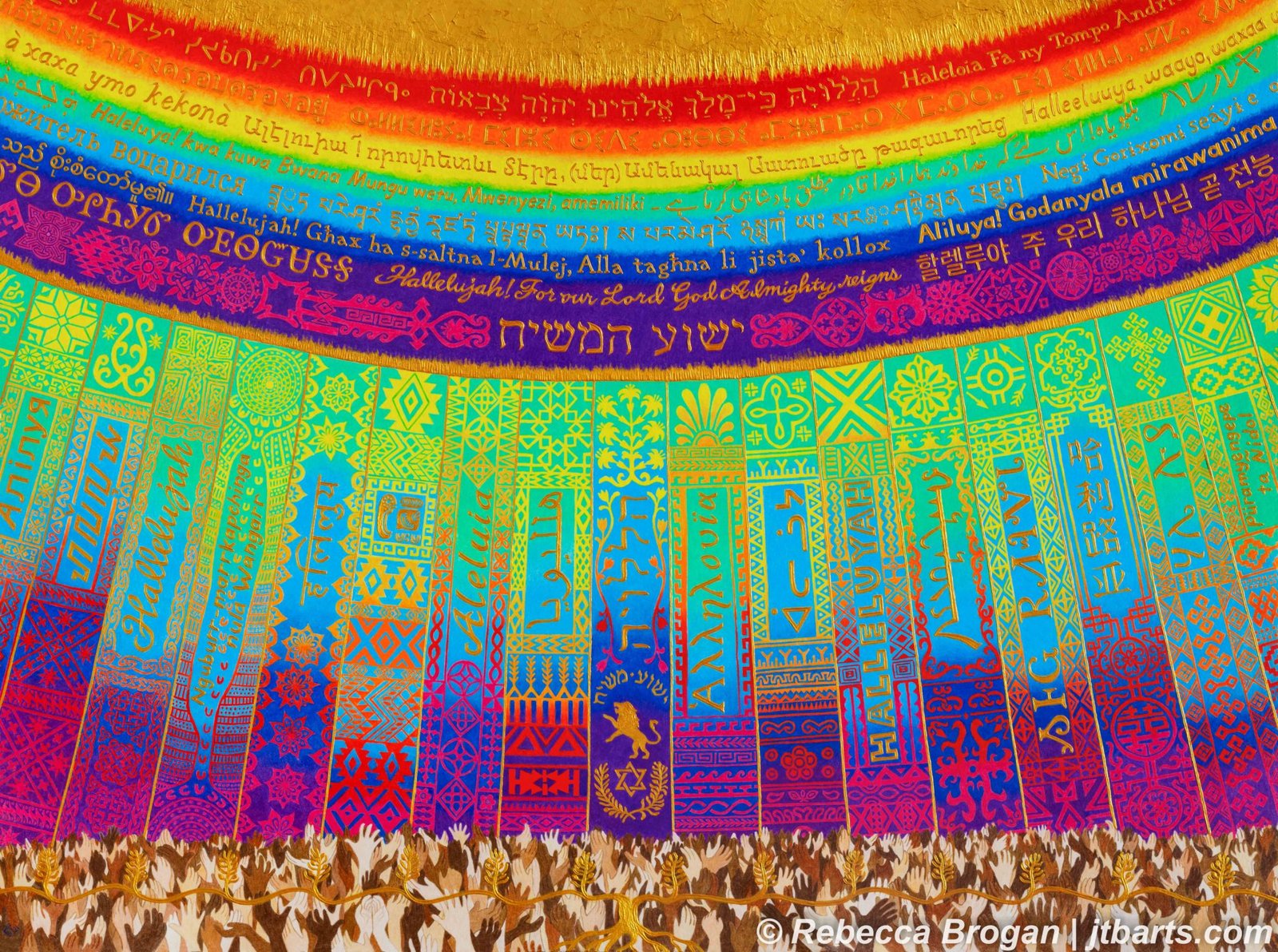
My drawing is a symbolic illustration of heaven in which people from every tribe, language, people and nation, who have been redeemed by the blood of “the Lamb” (Jesus), are worshiping before God’s throne. On the top, the phrase, “Hallelujah! For our Lord God Almighty reigns” (Revelation 19:6) is written in many different world languages. In the middle, the word, “Hallelujah” (meaning “praise the LORD”) is written in different world languages, along with some of the ethnic designs of the people groups who speak that language. Across the bottom, overlaying the worshipers, is an olive tree (from Romans 11:11-36), symbolizing believers from Gentile nations who have been grafted into the believing remnant of the Jewish nation. It is because of and through Jesus Christ (“Yeshua Hamashiach” in large Hebrew letters in the center), the Jewish Messiah, that Gentile believers can experience salvation.
ARTIST’S REFLECTION:
“You [Jesus] are worthy to take the scroll and to open its seals, because you were slain, and with your blood you purchased men for God from every tribe and language and people and nation. You have made them to be a kingdom and priests to serve our God, and they will reign on the earth.” (Revelation 5:9-10)
This drawing is an illustration of those who are in heaven.
How does one ensure that he or she will get to heaven? (This is the singlemost important question we could ever ask.)
God created us to be in a loving, personal relationship with him. He designed our relationship with him to last forever.
God is also perfect in holiness and righteousness and cannot be in the presence of sin. Sadly, because we have all sinned, we have all been separated from him, “…for all have sinned and fall short of the glory of God” (Romans 3:23).
God, who is perfect in love and justice, declares that the just punishment for our sins is death and hell, where we will be cut off from him eternally. “For the wages of sin is death, but the gift of God is eternal life in Christ Jesus our Lord” (Romans 6:23).
Thankfully God still loves us despite the fact we are sinners. He longs to redeem us so that we may enjoy a relationship with him. Therefore, he made the way for us to be reconciled.
“You see, at just the right time, when we were still powerless, Christ died for the ungodly…God demonstrates his own love for us in this: While we were still sinners, Christ died for us.” (Romans 5:6,8).
God sent his Son, Jesus Christ, to live the perfect, sinless life we could never live. Jesus then took upon himself all of our sins and bore the punishment for them through his death on the cross. He gave his life to ransom us from our sins (Mark 10:45). He rose from the dead three days later, making reconciliation with God possible.
“For God so loved the world, that he gave his one and only Son [Jesus], that whoever believes in him shall not perish but have eternal life.” (John 3:16)
In order to be reconciled to God and to enter into a loving, personal relationship with him:
You must first repent (confess and turn away from your sins).
Secondly, you must trust in Jesus to be your personal Savior. Believe that Jesus has paid the punishment for your sins by dying in your place.
When you receive him in faith as your Savior like this, then all of your sins (past, present and future) will be forgiven and eternally removed. You will enter into a loving relationship with God that will last throughout eternity. (See Message.)
This is how you get to heaven.
Getting into heaven isn’t about getting to a “place”; it is about getting to be with Jesus, a person, forever. Life, eternal life, is all about having a loving personal relationship with God and not primarily about getting to a “place”. If this is what we think, then we misunderstand the heart of what eternal salvation is truly about.
(To read of how people from all different countries, religions and backgrounds met Jesus, see Salvation Testimonies.)
Please visit Is God Real? if you have more questions about God.)
The people in my drawing have been redeemed by God out of every tribe, language, people and nation through the blood of “the Lamb” (Jesus). It is through faith in Jesus’ blood sacrifice of atonement on the cross that these people are counted worthy to stand and worship before God’s throne. They have entered into heaven based upon Christ’s sinless merit imputed to them through faith and not upon the basis of their own merits (good works) because our own good works will never get us into heaven (Read Galatians 2:15-3:14). God does not accept “good works” as the basis upon which we may enter heaven; the only basis upon which we may enter heaven is faith in Christ.
“No one is made right with God by obeying the law. It is by believing in Jesus Christ. So we too have put our faith in Christ Jesus. This is so we can be made right with God by believing in Christ. We are not made right by obeying the law. That’s because no one can be made right with God by obeying the law.” (Galatians 2:16 NIRV)
“For we maintain that an individual is justified by faith distinctly apart from works of the Law [the observance of which has nothing to do with justification, that is, being declared free of the guilt of sin and made acceptable to God].” (Romans 3:28 AMP)
The top of the drawing features the glorious presence of God upon his throne, symbolized by golden light radiating down upon the worshipers. The Bible speaks of a rainbow around God’s throne, so I have incorporated rainbow colors throughout (Revelation 4:3).
Multiple world languages over the rainbow immediately under God’s presence say, “Hallelujah! For our Lord God Almighty reigns” (Revelation 19:6). This is taken from the passage of Christ’s Second Coming in Revelation 19.
“Then I heard what sounded like a great multitude [in heaven], like the roar or rushing waters and like loud peals of thunder, shouting:
‘Hallelujah! For our Lord God Almighty reigns. Let us rejoice and be glad and give him glory! For the wedding of the Lamb has come, and his bride has made herself ready. Fine linen, bright and clean, was given her to wear.’ (Fine linen stands for the righteous acts of the saints.)
Then the angel said to me [John], ‘ Write, “Blessed are those who are invited to the wedding supper of the Lamb!”‘ And he added, ‘These are the true words of God.'”
(Revelation 19:6-9)
The world languages are as follows:
Red: Western Cree (Canadian Indigenous); Hebrew; Malagasy (Madagascar)
Orange: Thai; Berber (Tifinagh Script)
Yellow: Hixkaryana (Amazon Indigenous); Western Armenian; Somali
Green: Assyrian Aramaic; Swahili; Urdu; Japanese
Light Blue: Russian; Tibetan; Angave (Papua New Guinea)
Dark Blue: Burmese; Maltese; Pitjantjara (Australian Aboriginal)
Purple: Cherokee (Native American); English; Korean
Underneath this rainbow is the Hebrew phrase “Yeshua Hamashiach”, which means “Jesus Christ”, the Messiah, the only One through whom all nations of the earth may be saved.
“Salvation is found in no one else, for there is no other name [Jesus] under heaven given to men by which we must be saved.” (Acts 4:12)
Extending from “Yeshua Hamashiach” to the left in pink are ethnic designs from people groups living in geographical order from east to west starting from Jerusalem.
Extending from “Yeshua Hamashiach” to the right in pink are ethnic designs from people groups living in geographical order from west to east starting from Jerusalem.
Beneath this rainbow around God’s throne are additional rainbow colors, the colors of the praise and worship of the nations ascending to Jesus Christ. These feature the word “Hallelujah” in many different world languages along with the ethnic designs of the peoples who speak that particular language.
I must note that I spent 70+ hours researching and drafting this drawing (and 500 hours more actually drawing it). Most of my research time was spent investigating the meanings of the ethnic designs in order to avoid the symbols which had intrinsic pagan spiritual meaning. The message of this drawing is NOT syncretism. I did not want to use any ethnic designs syncretistically. I tried my very hardest to ensure this. If I missed a design or two, I sincerely ask God to forgive me for any unintentional and unknown usage of an ethnic design that had pagan spiritual meaning.
To learn how to contextualize Christianity within different world cultures and how to avoid syncretism, I highly recommend Craig and LaDonna Smith’s podcast “Indigenous Faith” along with their books and teaching materials on this subject, especially their “Summer Conference” podcast at the bottom of the page on that link. Their extremely superb and in-depth exposition of the Scriptures regarding questions about what we as Christians can keep, what we can change and what must we throw away from our cultures (mostly focusing on Indigenous cultures from animistic backgrounds) is highly informative and comes from decades of dealing with these questions from a Biblical perspective as well as much practical experience in combatting the supernatural powers of the enemy’s kingdom working through animism. They also draw upon the wisdom and experience of Native American medicine men who have been saved by Jesus Christ out of shamanism and now help people who have been involved in shamanistic religions get set free from these demonic powers by the power of Jesus. Craig and LaDonna’s Biblical teaching formed the basis of how I evaluated the ethnic designs in this drawing. This is an excellent resource not just for Christians coming out of animistic religions or missionaries working among animistic peoples, but it is also powerful Biblical teaching for the average Western Christian too.
Also, I must testify of the most amazing thing that happened while I did this drawing. I was at Salamanca Market working on it one day, and a certain man took a keen interest in it. We got to talking and he said that he was actually friends with the husband and wife couple who translated the Bible into Burarra, an Australian Aboriginal language, which I had put into my drawing. That was super cool! I had him take a photo of the Burarra to ask the translators if I had copied it correctly because the website I had copied it from was very old and not functioning well. They wrote me back saying that there was, in fact, a small typo in it. They then gave me the correct wording.
Hallelujah!
How totally cool is that?
God knew that there was an error in the Burarra, a language spoken by only about 2000 people in northern Australia, but God cared enough about my drawing and its message that he randomly connected me, way down in Tasmania, with the translators on the opposite end of Australia in order to correct it.
How cool is God?
God cares. God cares about the Burarra people, and he cares about the message in this drawing because he loves the whole world.
Across the bottom, from left to right, the languages are as follows:
1) Kazakh (design almost totally cut off on the left)
2) Ukrainian
3) Sundanese (Indonesia)
(Actually, the Sundanese has a crazy story behind it too. My husband, Joe, was watching me work on this drawing, and I pointed to the Sundanese and taunted him, “I will give you a million dollars if you can tell me what country this language is from.” He looked at it very intently for a minute (without any help from the internet) and answered, “Java”. My mouth fell open to the floor. I couldn’t believe he had actually gotten the exact island in the exact country where Sundanese is primarily spoken. He said, “Pay up. You owe me a million dollars.” I said, “No. You got the wrong answer.” Joe said, “What do you mean I got the wrong answer? I got the exact right answer!” I told him, “No, you didn’t. I asked for the name of the country, but you told me the name of the island. Besides, I would have to pay you out of your own bank account because I don’t have enough.” He thinks I’m a cheat.)
4) English
5) Burarra (Australian Aboriginal)
6) Hindi
7) Mayan petroglyphs
8) Polynesian languages
9) Arabic
10) Hebrew
(The smaller Hebrew gold letters say “Yeshua” (Jesus) and “Mashiach” (Messiah). The golden lion stands for the Lion of Judah (Jesus) from Revelation 5:5. Underneath him is a the Star of David, representing Israel. Underneath is an olive branch (representing the kingship of the Messiah (2 Samuel 7)) and an almond branch (representing the high priesthood of the Messiah (Hebrews 7-8). Furthermore, all of the floral designs around the Hebrew were taken from the embroidery on a Jewish wedding dress because this drawing commemorates “the wedding supper of the Lamb” (Revelation 19, Matthew 22:1-14))
11) Greek
12) Inuktitut (Inuit)
13) Yoruba (Nigerian)
14) Mongolian
15) Cherokee (Native American)
16) Chinese
17) Amharic (Ethiopia)
18) Mapudungun (Mapuche, Indigenous people of Chile and Argentina)
19) Cambodian (design mostly cut off on the right)
Across the bottom of the drawing are worshipers from every nation, tribe, people and language.
Beneath the central Hebrew section is an olive tree. This references (the patriarchs of faith of) Israel from Romans 11, whom the Lord describes as “the root” of a cultivated olive tree in whom Gentile nations, likened to wild olive shoots, have been ingrafted through faith in Christ.
In describing the Israelite patriarchs of faith as the root of a cultivated olive tree, the apostle Paul says:
“…if the root [of the cultivated olive tree] is holy, so are the branches. If some of the branches have been broken off [the Jews who rejected Jesus as their Messiah], and you [Gentile believers], though a wild olive shoot, have been grafted in among the others and now share in the nourishing sap from the olive root, do not boast over those branches. If you do, consider this: You do not support the root, but the root supports you. You will say then, ‘Branches were broken off so that I could be grafted in.’ Granted. But they were broken off because of unbelief, and you stand by faith. Do not be arrogant, but be afraid. For if God did not spare the natural branches, he will not spare you either.
Consider therefore the kindness and sternness of God: sternness to those who fell, but kindness to you, provided that you continue in his kindness. Otherwise, you also will be cut off. And if they do not persist in unbelief, they will be grafted in, for God is able to graft them in again. After all, if you were cut out of an olive three that is wild by nature, and contrary to nature were grafted into a cultivated olive tree, how much more readily will these, the natural branches, be grafted into their own olive tree!”
(Romans 11:16-24)
The golden olive tree roots and its immediate branches beneath the Hebrew represent the Jews of Israel who have believed in and received Jesus as their Messiah. Every other branch, stretching across to the right and left, represents believers within the Gentile nations who have been “grafted in” to believing Israel.
Have you trusted in Jesus Christ as your personal Savior and Lord?
There is no other way to heaven.
(Please see: “Message”)